IMMIGRATIONHUMANITARIAN & COMPASSIONATE (H&C) APPLICATIONS
At Solvis Law, we make the H&C application process as clear and seamless as possible. Our team provides strategic legal guidance, tailoring every case to the client’s unique circumstances.
From start to finish, we work closely with you, developing a personalized strategy and offering step-by-step support. We help identify and gather the right documents—letters of support, proof of employment, medical records, and other key evidence—to build a strong, well-prepared application that tells your story effectively.
Our goal is simple: to maximize your chances of success and advocate for the relief you deserve.
What is an H&C Application?
H&C applications offer a unique pathway for foreign nationals to apply for permanent residence in Canada when they do not qualify under other immigration programs. This process allows individuals to request an exemption from standard immigration rules due to exceptional circumstances, as outlined in Canada’s Immigration and Refugee Protection Act (IRPA).
Unlike traditional immigration pathways, an H&C application is not an immigration program but a request for special consideration under section 25 of the IRPA. It is not a right, but a privilege, granted only in rare and compelling situations where strict enforcement of immigration laws would cause undue hardship. Each application is reviewed on a case-by-case basis, requiring strong supporting evidence to demonstrate why the applicant should be allowed to stay in Canada on humanitarian grounds.
Key Factors Considered in H&C Applications
Immigration officers carefully review a variety of factors to determine whether an applicant qualifies for humanitarian and compassionate relief, including:
- Establishment in Canada – this factor includes length of stay, employment history, community involvement, and overall integration.
- Ties to Canada – Family connections, friendships, and support systems.
- Best Interests of the Child – How the decision affects any children involved, directly or indirectly, including those who are not Canadian citizens or those who are residing outside Canada.
- Country Conditions – Adverse conditions in the applicant’s home country, including safety, security, and human rights concerns.
- Health Considerations – The availability (or lack) of adequate medical treatment in the home country.
- Family Violence – Any history of abuse or risk of harm if returned to the country of origin.
- Consequences of Family Separation – The impact of splitting up families due to immigration enforcement. Family ties are not only about proximity but also about the depth and significance of the relationships involved.
- Inability to Leave Canada – Situations where an applicant cannot return to their home country due to circumstances beyond their control.
- Ability to Establish in Canada – For those applying from outside Canada, their potential to successfully integrate into Canadian society.
- Other Unique Circumstances – Any additional compelling factors that demonstrate why relief should be granted.
Humanitarian and Compassionate (H&C) applications are among the most complex and demanding immigration processes in Canada. Success requires more than just a deep understanding of immigration law—it demands the ability to build a compelling case that seamlessly integrates legal arguments, strong supporting evidence, and powerful personal narratives. The approval threshold for H&C applications is exceptionally high, as applicants must demonstrate that their unique circumstances warrant exceptional relief.
The Importance of Hardship in H&C Applications
A core component of an H&C application is the hardship an applicant would face if required to leave Canada. While hardship alone is not a sufficient reason for approval, it plays a crucial role in shaping a compelling case. Applicants must provide a well-documented and persuasive narrative explaining why returning to their home country would cause undue suffering and why staying in Canada aligns with the compassionate principles of the IRPA.
Unique or Exceptional Circumstances
A key element of a Humanitarian and Compassionate (H&C) application is the hardship an applicant would face if required to leave Canada. While hardship alone is not enough for approval, it plays a critical role in shaping a compelling case. Applicants must present a well-documented and persuasive narrative explaining why returning to their home country would result in undue suffering and why staying in Canada aligns with the compassionate principles of the IRPA.
At the heart of many H&C applications are unique or exceptional circumstances—situations that do not fit within traditional immigration pathways but warrant special consideration based on fairness and compassion. These circumstances help tie together various factors in an application, illustrating why an exemption under Section 25(1) of the IRPA is justified.
In our experience, applications with clearly defined, exceptional circumstances have a higher chance of success. These circumstances can cover a broad range of situations, including:
- Survivors of Trauma – Domestic violence, severe injury, or other life-altering experiences in Canada.
- Barriers to Returning Home – Political instability, persecution, or the loss of essential support networks in the applicant’s country of origin.
- Exceptional Contributions to Canada – Demonstrated positive impact on Canadian society, reinforcing deep community ties.
A Highly Personalized Process
Each H&C application is unique, and success depends on presenting a clear, comprehensive, and well-supported case. Immigration officers assess applications with sensitivity, recognizing that hardship can take many forms. Strong supporting documents, personal statements, and legal arguments are essential to building a compelling application.
Applying for permanent residence through humanitarian and compassionate grounds is a complex process, but for those facing significant hardship, it may provide a pathway to a more secure future in Canada.
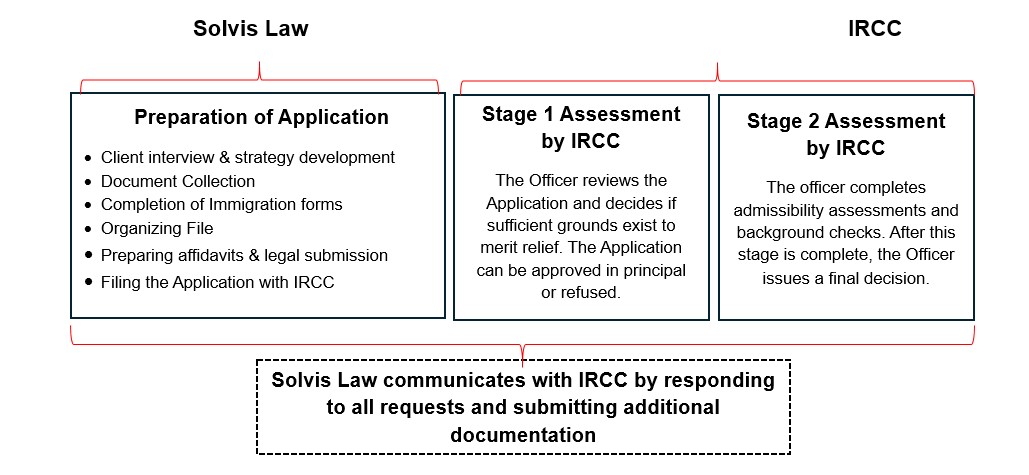
GENERAL OVERVIEW OF THE H&C PROCESS